Monday, July 31, 2023

Spotting seabirds on Anglesey

Who are you looking at?
 On the very western tip  of Anglesey a  series of  steep cliffs rise  dramatically from the  Irish Sea. These cliffs  are homes to vast  numbers of seabirds  including puffins,  razorbills, kittiwakes  and guillemots. An  overnight visit to the  lovely seaside village of  Trearddur Bay allowed  us to zip a few miles up  the coast to the RSPB  South Stack bird  sanctuary to view some  of these in their glory.  The puffins had gone off for a wander somewhere else unfortunately but there were thousands of guillemots chattering away on the cliffside. Here is a group of three old birds in discussion, the one with a white ring around her eyes is a bridled guillemot, the reasons are unknown but about one in twenty of them has this distinctive feature. Apart from gossiping on the cliffs they spend more time diving than they do flying and have been known to reach depths of almost 600 feet! There were a few razorbills around but they have very similar colouring to guillemots and from a distance we couldn't tell which was which. A little further away on the island that houses the lighthouse we spotted a large colony of kittiwakes which are a type of noisy seagull with a short neck.

Come and put a nickel in.....
Our evening meal at Trearddur Bay's swish Ocean's Edge restaurant was rounded off with a Kelly's ice cream at the Sea Shanty where we spotted an orchestrion in the foyer of the cafe. Prior to the advent of juke boxes companies such as Wurlitzer, and in this case Seeburg, devised coin operated music machines. This one, made around 100 years ago, has a piano inside together with pipes and percussion instruments. We're talking here about the golden age of pre-electronic music making and well before the advent of the Hammond organ. From steam powered fairground organs to the mighty Wurlitzer a huge variety of inventive contraptions were produced to entertain the masses. Sadly few examples of these still exist. (The Great Dorset Steam Fair would be the place to see fairground organs - apparently they have the biggest gathering of them in the world, forty at least. Maybe a treat for 2024?)


Monday, July 3, 2023

Flying Bishops and Geese


St James in the Evening
On a fine early summer evening we found ourselves in the north  of Buckinghamshire at the village of Hanslope. We'd been invited to attend a confirmation service being delivered by the Bishop of Oswestry at the church of St James the Great, another of the magnificent churches of England and Wales that we've visited recently. (If you're into Norman chancel arches this is the place to come!) The tower is especially impressive and can be seen for miles around - it was 200 feet tall but a bit fell off a couple of hundred years ago when it was struck by lightning and it's now a mere 187 ft. Quite why the Bishop of Oswestry is responsible for diocesan visits this far away became clear when it was explained to me (by another bishop) that he's a 'flying bishop', well it seemed clear at the time!

Heading back northwards the following day we found our route blocked by a gaggle of geese. Calling in at the RSPB reserve at Middleton Lakes near Tamworth we spent a pleasant and peaceful couple of hours tootling round the trails through what used to be a huge system of gravel pits in the middle of the industrial West Midlands. These somewhat assertive wildfowl are Greylag geese which in the 20th century had all but disappeared from the UK due to destruction of their breeding sites, but they're back (and doing a bit of breeding here as you can see, well you can see the results of the breeding!) We carefully skirted round to the left closely monitored by the protective parent birds.

Offa, King of the Midlands
And thence to Lichfield for an overnight stay followed by a parkrun round Beacon Park in the middle of town. We were very close to the city centre and a stone's throw away from the imposing cathedral. Thinking that we could have a gander (!) inside the cathedral we approached  to hear the unmistakeable sounds of Hotel California and to see barriers across the west door. An Eagles tribute band were tuning up for a concert by candlelight later that evening and we could already see one or two aged rock fans trundling around the side streets. And why not if it raises some funds for upkeep of the building, but did St Chad turn in his grave? Before we left we looked up at the cathedral frontage to see an assembly of carvings of various royal figures which have been added over the centuries, there's even one of Queen Victoria which was carved by her daughter Princess Louise. I didn't spot that one but I did manage to get a snap of one of our favourites - Offa, King of Mercia.


Sunday, May 28, 2023

A Spartan Hero

Visiting Northern Ireland again to catch up with the wee grandsons we approached our George's house from an unfamiliar direction. On a twisty narrow road in the middle of nowhere we came across this small unprepossessing church. It's not of particular architectural merit compared with many we've seen lately and it's not of recent vintage being was built in 1755 by a Moravian priest who needed somewhere for his flock of 80 parishioners. The nascent Moravian congregation dwindled however and, by 1834, the church was in a poor state of repair. Enter Basil Zula, a senior army officer from the ancient Greek area formerly known as Sparta, he was on the run from the Turks following a 19th century Greek revolution. Basil was lucky enough to meet a young Irish girl who could converse in Greek. The Irish girl Ann, was a Moravian worshipper and she and Basil took on the task of rebuilding the church. What's more Basil married Ann, he was ordained a minister and the congregation thrived - it's still going strong and we watched some of the parishioners arriving on this fine Sunday morning. Back in the 19th century Basil had clearly not shaken off his concern that the Turks might come after him even in this remote  part of Northern Ireland as he incorporated secret passageways and hiding places in the church and attached rectory. Furthermore in his spare time Basil built a series of impressive earthworks  between the roadside and the church buildings. This was what caught our eye as we were driving past. This curious arrangement consists of mounds around 15 feet high with valleys and bridges connecting them - these represented the landscape where the ancient Battle of Thermoplyae was played out. This was clearly a scale model but Basil must have looked wistfully out of his window and imagined the mighty tussle taking place!

300 Spartans held back the might of the Persian army


On our visits to Northern Ireland we always aim to go for a parkrun that we've not done before and over the years we've ticked off most of the events in the Belfast area. We've done the attractive sounding locations such as Stormont and Hillsborough Forest and we're now picking out the remaining few. Orangefield Park didn't sound too exciting but it had to be done. I knew it was in a fairly run down area of the city and as we approached it things looked a bit grim. However we were pleasantly surprised by the extent of the parkland we found between the old housing estates. The route, as shown on the map, weaves around the undulating Orangefield and Greenside parks which are part of a 'greenway' which links the city centre to the outer suburbs allowing walkers and cyclists to roam on a traffic free corridor. And so at 9 am an enthusiastic crowd of just over 100 made their way round the course. A fine way to start the weekend!

Sunday, April 30, 2023

Middle of Somewhere!


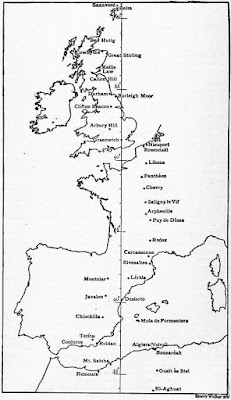
There's a small town near Solihull in the Midlands called Meriden and for a long time this was held to be the centre of England. However the Ordnance Survey in 2020 made some new calculations - which in fact anyone can do without the aid of maths skills. Basically all you have to do is make a cardboard cutout of a map and find the point where it will balance on the tip of a pencil. This in geometric parlance is defined as the 'Centroid' and the OS found that England's centroid is in a field in Leicestershire.  (The Centroid of the UK is in the middle of Morecambe Bay - there's a thing to ponder on!) The place name Meriden comes from the Old English for 'pleasant valley' and it's only coincidental that the the town's location is somewhere in the middle of the country. However the somewhat similar word 'Meridian' is certainly connected to the middle of something as it comes from the Latin word for Midday. And so, at around midday, we stood on the Meridian line in the middle of Louth in Lincolnshire. Any place on the Meridian Line, as any schoolboy used to know, has a longitude of zero. Following a Saturday parkrun round the pork pie metropolis of Melton Mowbray we had headed up for a short break in Louth, an unspoilt market town somewhat off the beaten track but bang on the line that heads north from Greenwich (as illustrated in the above chart.)
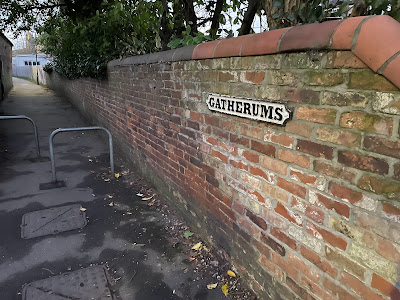

Gather whats you might well ask!

Louth is full of little ginnels or alleyways connecting the various ancient streets, here's one called Gatherums, we also came across others called Paradise Smoot and Kitkat which all seemed to lead towards what was formerly a rather disreputable part of town called Aswell Hole. This is the site of an important spring which provided a water supply for the fulling industry. Fulling was a medieval process for cleaning wool ready for weaving and you can imagine the Lincolnshire Wolds sheep farmers bringing fleeces to market many years ago. These farmers might well have also refreshed themselves with the products of the breweries located close to the spring. We took a walk along Gatherums and found a plaque in the pathway delineating the Meridian Line - here we were at Longitude Zero - what excitement! 


Poor Thomas!
 Here's a fine view up West Street  towards St James Church which  happens to have the tallest steeple on  an English medieval church. And an  imposing church it is too with fine  stained glass windows one dedicated to  one Philadelphus Coltman who lived to  the ripe old age of 89. St James was  where the Lincolnshire Uprising began  in 1536, this was a protest against  Henry VIII's suppression of the  monasteries and eventually 40,000  demonstrators marched to Lincoln  (that's a lot of sheep farmers!) The  rising was put down by the military and  the ringleaders were arrested. As a  teenage boy I frequented a fish and  chip shop in our village run by a couple  called Tom and June. June and her  assistant chatted away every evening  to the post pub crowd who came in for their pudding and chips, whereas Tom didn't say much. One thing that I did hear him say, very authoritatively, on several occasions was "They never hung a Thomas!"  which I remembered for many years. Various Thomas's were despatched in medieval times using a number of traditional methods, Thomas Cromwell lost his head, Thomas Cranmer was burned at the stake and, as we found out in deepest Lincolnshire, Thomas Kendall, the vicar of Louth was hung at Tyburn for his part in the uprising!

We didn't confine ourselves to Louth itself despite it's wealth of attractions. It's about half an hour to the coast from Louth and we took a trip down quiet country lanes to Mablethorpe, an ice cream and amusement arcade seaside town surrounded by caravan parks. Several miles north along the coast road we took Skip for a walk into a vast nature reserve. In the midst of the huge area of marshland and beaches we spotted the remains of a battle tank (marked on Google Earth!) which is apparently a bit of a tourist attraction. Well we did find one other visitor there who told us she regularly walks her dog here. I found out later that the skeleton was of a Comet tank which was the predecessor to the Centurion tank, this particular one had been used as target practice by the RAF! So in brief this was an eventful trip full of unexpected surprises, if you want to find a corner of England that seems to have not quite made it into the 21st Century try Louth. We enjoyed the peace and quiet and the unspoilt town centre (and the pubs!)

Monday, February 20, 2023

On the hunt for rare butterflies


Here's a pretty little thing, it's a Pearl Bordered Fritillary and there are a bunch of them breeding prolifically in the hills of south Denbighshire. More specifically the location of these butterflies is Eyarth Rocks at Pwllglas near Ruthin, here is a limestone pavement of rock on top of a hill overlooking the Vale of Clwyd.

It's the perfect habitat for butterfly colonies as it happens, the key ingredients being bracken for cover and in the understorey, violets for the caterpillars to feed on; the exposed limestone absorbs the warmth of the sun and retains it over night - thus they have food, shelter and central heating. What more do they want? Caterpillars in general are fussy eaters - Fritillary caterpillars are very fond of Violets and the Pearl Bordered Fritillary feeds on Dog Violets in particular which grow well on the Eyarth hilltops. And what did we see today on our winter walk at Pwllglas? Lovely views of the Vale of Clwyd but, alas, no butterflies fluttering by - the earliest sightings are in April.

And what did we see today on our winter walk at Pwllglas? Lovely views of the Vale of Clwyd but, alas, no butterflies fluttering by - the earliest sightings are in April - these early hatchers will be the Small Pearl-Bordered Fritillary, a close relative to the one pictured above. There are, in fact, eight species of butterfly to be found here as listed on the right - it must be a magnet for lepidopterists. We'll have to join them in the spring!


D Duck the famous American lepidopterist!


Tuesday, January 31, 2023

And back home in January!


Hold him down otherwise he'll blow away!
There we were at the summit of Tegg's Nose just outside Macclesfield. Cold and windy it was too, somewhat of a contrast to the warmth of down under. But, as we were in the vicinity and it was lunchtime, we called in to the cafe near the top and then took a walk around old haunts. It's an impressive hill, even more impressive if you're running up the big climb in the Tegg's Nose Fell Race which I've managed half a dozen times in the past. It's a real old fashioned event held in conjunction with the Langley Sheepdog Trials and the race was usually started by the local MP Nicholas Winterton (who claimed to have run it himself in younger days.) The views from the peak are   spectacular and, on a clear day, you can see Welsh mountains in the far distance.


We're back running in a somewhat colder climate now and, taking advantage of a trip to the Midlands to say goodbye to Jane (emigrating down under!) we nipped over to Nottingham to do the Wollaton Hall parkrun. Two weeks ago we'd been warned about the possibility of snakes on the course but today the race director drew our attention to the hazards posed by galloping deer! The previous week a large herd of deer had crossed the path of the parkrunners and they just had to wait, you wouldn't want to get in a tangle with a Red Deer stag - they can weigh well over 30 stone! Wollaton Hall is a fairly grand stately home built by a 16th century coal magnate in an imposing position on top of a hill four miles from the 

That's the Joker peeping out from top left.
centre of Nottingham. And the jolly parkrun marshals sent us up that hill to run past the front door of the mansion, down the hill on the other side and back up and down again. All good fun on a Saturday morning. This magnificent Elizabethan building featured in a scene from The Dark Knight Rises, a Batman film from a few years ago. Entitled Wayne Manor this was depicted as the home of Batman complete with butler (Michael Caine of course!) There's a twist to the tale, just a short drive away just beyond the suburbs of Nottingham lies the village of Gotham which lent its name to Gotham City, the fictional home of Batman!

Tuesday, January 3, 2023

2023 - this is the year!


First parkrun of the New Year on a humid warm morning, thank goodness they start at 7 am in Queensland! This is the North Lakes parkrun which is held in a sociable suburb of Brisbane some 15 miles north of the city. North Lakes was created as a new town less than 20 years ago and it's now a busy little place as evidenced by the 200 or so runners who gathered for a merry jaunt three times round the parkland that surrounds the lake. The huge shopping centre has all the big stores including an IKEA. And that's just about all I can find to say about North Lakes, there's nothing much going on of note part from the fact that some of the residents were upset about three years ago about plans to close the golf course and develop it as a retirement village.

And a week later we were at the very different Glass House Mountains Conservation parkrun, a lovely low key off road event with the longest parkrun name in the world. We parked up alongside a row of cars by the roadside and a small number of us gathered at the start of a little used forest trail - slightly downhill for 2.5K until the halfway point then back up. The leading runners saw a kangaroo bouncing away from them but I wasn't quite fast enough. Then back to Woodford for breakfast at CJ's, famous for their pies and pastries, looking at what they had on offer I would have happily come back here for lunch as well. Technically the parkrun is in the Beerburrum West State Forest Park which is south of the Glass House Mountains District Park so we headed north to the mountain lookout to see the panoramic view of these impressive mountains. They were formed through volcanic activity 26 million years ago, the surrounding sandstone has gradually worn down to leave the harder volcanic plus which form the dozen or so striking present day peaks. On the left of the photo is Mount Beerwah, the tallest mountain at 556 metres, on the right is the pointy peak of Mount Coonowrin - several climbers have been killed and seriously injured attempting to reach the top and access to the summit is now prohibited with spot fines of the princely but odd sum of $431 payable by transgressors.